"Timer" for the Player
Platform: Mobile App, iQIYI
Operation system: iOS, Android
Duration: 3 months
My Role: Product designer
Key words: Demand Complexity, Data Analysis
Presentation


BACKGROUND
Introduction
iQIYI is currently one of the largest online video companies in the world, offering TV dramas, movies, variety shows, animation, and other quality contents. Nearly 6 billion hours spent on its service each month and over 500 million monthly active users.
Back to September, 2015, the number of registered users in the mobile platform of iQIYI up to 100 million. At the end of 2015, among the categories of "Entertainment" in the Android and Apple App stores, iQIYI achieved the top 1 for the time every user spend online. Watching entertainment contents like series, films, variety shows in iQIYI became a lifestyle for thousands and millions of Chinese people, replacing the traditional behavior---watch TV.
Problem statement
Through the monitor from our feedback database, the report a timer keep increasing in a row of three months. Although these users didn't know each other and come from different province in China, but their feedbacks are similar.
"I need a timer, now I usually wake up with my phone power off."
There are two questions I need to answer:
-
Why people know "a timer" can satisfy their demand, whether some competitive app already launch this function?
-
What is the relationship between "Timer" and power off, what is the scenario?
My Role
-
User research, the process includes: interview users
-
Define the demand and discuss its necessary with our product team
-
Study the construction of the player
-
Delivery the Product Requirement Document(PRD) draft, first version wireframe and prototype
-
discuss the scenario and logic flow with other product designer
-
Delivery the logic flow, Wireframe and low-fi prototype
-
Output the Hi-fi prototype and final Product Requirement Document(PRD)
-
Explain PRD to developers, testers and UI designers; Track the process of development
-
Monitor and report the performance to all the related department after it was launched
To answer the first question, I chose to do a competitive analysis; for the second question, I decided to do an interview with those users.
Demand Definition
Competitive Analysis
There is no similar function among competitive analysis. In the streaming media market, only two online live applications(huya.com, douyu.com) have the function of "Timer". The demand is decided by the nature of the contents-- usually their online live is about playing games or sports events, which the time is long. On the other side, because of the time zone, many sports events happen in the midnight. A timer is necessary.

User Research
I take two weeks to do this user research. The resource of our users is feedback database. Every afternoon I interview about 10 users by phone call. This investigation has the following constructer:
Make the interviewee relax before enter our topic
Talk about their hometown, job, family or hobbies......
Observe and understand their behavior patterns on iQIYI App
Let them talk about their story with our App; How they use it in daily life; How they spend their free-time;Why they have the demand of Timer.
How they think about iQIYI App
Let them talk about their suggestions or complains about iQIYI
From the interview with users, I get the following conclusions:
1.The change in iQIYI App
Recently, our player added a new default function--Continued Play, which means people can see video even without clicking the button. For our platform, the major contents are teleplay and variety shows, This is especially convenient for users to watch them. But on the other side, the player will keep playing videos if users forget to close it.
2.The pain point for our users
The player will keep playing until the phone power off and the screen never turn off.
Many users tended to use it when they sleep or in a very lazy time. In this condition, people easily fall asleep or relax to pay attention to the player. Two bad confluences for users: there is always noise while they are sleeping; they cannot use their phone when they wake up.
The core of users' demand--Our App can offer a function for them to control the time to turn off the screen.
Brainstorm
"Timer" is actually a mature function in the market of online live application and music application. People already have a basic recognition of this function. To make sure people will not feel confused when using it, this design will keep correspondence with other apps, but change a little according to features of our platform.
1. The settings place---"Settings" in the player VS App settings page
This function aims to control the player itself, users' first choice is to look for the setting button in the player page. So I designed the setting button in the player.
"Settings" in the player
App settings page


2. The reminder of "Timer"
What is the result when the time is up? Pause videos VS Close the App
I answer this question according to the core of demand--turn off the screen. When users use our App, only one condition the screen will keep on until the phone power off--the player is playing. Therefore, the function should just trigger the player to stop playing and still stay in the current player page. This is a gentle solution, compared to turning off the app, which looks like a bug.
How to remind people the time is up?
People set timing to remind them to do something, so there must be a reminder before the time comes to let our user know. This reminder must be obvious enough since this is an interactive users active site. Therefore, when the time approaches, a half-transparent mask will cover the player to tell the users. If users browse other pages in the App. No reminder will show since the screen can turn off automatically.
Full screen

Stop playing
Continue playing
Half screen
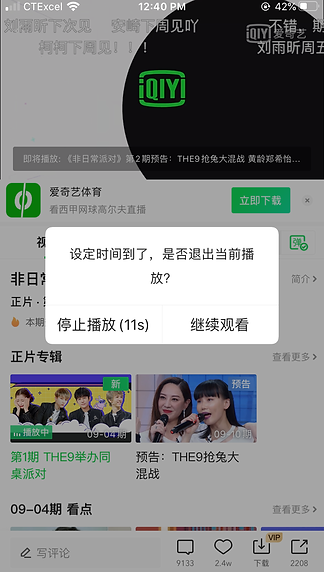
Stop playing
Continue playing
3. The time segments
Up to the episode end | 15 minutes | 30 minutes | 60 minutes | 90 minutes
Basic on people's basic recognition of time. Usually we could offer different time lengths for people to choose, like 30 minutes, 1 hour and 90 minutes. However, since the major content of iQIYI is the teleplay or variety shows, which consists of episodes. These episodes have a high correlation and people have the demand to watch them one by one. So one special unit of time length in "Timer" is the length of current episodes. Maybe in the future, people can customize their own time length in this function.
Complexity analysis
In the stage of demand evaluation, this function is seen as a medium-complexity project. Because "Timer" attaches to the player, but it can control the open state of the whole APP. Therefore, the previous study of the player is necessary.
This new function is related to many different types of user behavior, so there are many branches in the logic flow. Therefore, we did these from two dimensions.
Function complexity
As the play is the basic and largest business branch in our company, every function and business branch needs to interact with it in the level of information structure and database. So I need to study how players receive and send data, and whether the possible design can work well in the current structure of the player. Another important part is checking the work style of Android and iOS, sometimes the difference between them needs me to prepare two sets of design schemes. In this design, I learnt this function needs three parts to work together: foreground system, middle-player system, the underlying system. Every time I need to send my thoughts to every department to discuss.
Besides, when the player pauses, the App needs to tell the phone to turn off the screen according to system setup. So actually this function also interacts with the phone system.
Logic complexity
Although it is only a switch of "Timer", there are many possible scenarios that will influence the display and logic flow of this function when the switch is on. In this stage I design the interface and logic flow in two view:
The player
Full-screen
Half-screen
Outside the player page
The users behavior
Whether the user close the app when the function is on.
Users stays in the play, how the interface will be when the time is up:
-
without any action( maybe the user is sleeping)
-
click "Stop playing"
-
click "Continue playing"
-
click other places of the mask
Logic Flowchart
According to carefully function analysis and logic analysis, I set the logic flow chart as following:
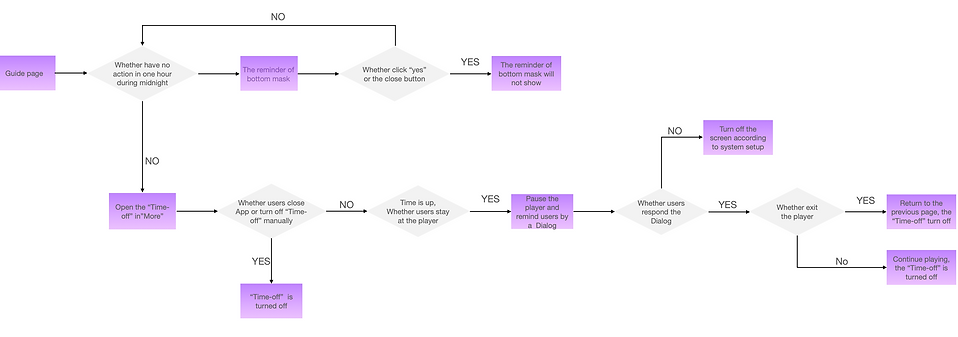
Data analysis
Overall Situation
After launched, the number of click and users of the "Timer' :

Delete the first day of online, the average number of usage time is 93592 everyday, the average number of users is 65063 everyday, the percent of users of "Timer " among every the users of player is 0.26%, it is a normal proportion as a advanced function and compared to the data of feedback. At the same time, the peak of data is according to the peak of the player's data.
Every user behavior
Time segments---the number of click and percent:

The time-up dialogs---The number of click and percent for every button:

The number of people who have no action on the dialogs means that users fall asleep when the time is up. It shows that the function actually helps people who need a timer when they fall asleep with the player open.
Once users have action on the dialogs, most of them choose to continue playing.
At the same time, there is almost no feedback about Time-off function again every week.
Conclusion: These numbers show the behavior of users that match our expectations. The function works well.