Ice Cube---Installation for Coral Bleaching
BACKGROUND
Once vibrant and colorful, corals in the ocean are now facing widespread decline. One of the primary causes of coral degradation is global warming, a consequence of human activities, particularly those affecting the ocean.
Rising water temperatures can lead to coral bleaching. When the water becomes too warm, corals expel the algae living within their tissues, causing them to lose their color and turn completely white. This bleaching process weakens the corals, making them more vulnerable to disease and environmental stressors.

CONCEPTION
This project utilizes human activity data to simulate the process of coral bleaching. However, since raw data on human activities is not openly accessible, an ultrasonic sensor was used instead. The sensor detects a person’s distance from the installation—the closer they are to the corals, the fewer corals survive, illustrating the impact of human presence on marine ecosystems.
Materials Used:
• 3D-printed models
• Hot glue stickers
• Mini vibration motors
• Ultrasonic sensors
• LED strips
• Arduinos
Representing Coral Life and Natural Beauty
Each coral is represented by a milky cube made of hot glue, symbolizing purity and softness.
• Purity reflects corals in their uncontaminated, natural state.
• Softness conveys their delicate yet vibrant nature.
Inside each cube, a vibration motor creates subtle movements, signifying that the corals are still growing and active, reinforcing their living, dynamic presence.

MAKING PROCESS
3D-Printing
The base was designed to support 12 cubes. Due to the size limitations of the 3D printer, the base was divided into four separate pieces for printing and then assembled into a complete structure.


Molding Process & Core Assembly
Initially, a 3D-printed mold was used to shape the hot glue cubes. However, due to the high melting temperature of hot glue, the plastic mold also melted during the process.
To solve this issue, veneer was used instead. Laser cutting was applied to precisely shape the pieces, which were then assembled into a detachable, reusable mold.
During the molding process, LED strips and vibration motors were embedded in the center of each hot glue cube, forming the core of the installation.


Circuit Connection
In this step, the circuits were connected to power the installation. Initially, a series circuit was used to connect the LED strips.
Pros & Cons of the Series Circuit:
• Advantage: Saved space and kept the back of the installation tidy, as the wires only needed to be long enough to connect to the next cube.
• Disadvantage: If one LED failed, the entire circuit would stop working. This issue occurred during testing.
To resolve this, the circuit design was switched to a parallel connection, ensuring that a single LED failure would not affect the rest of the installation. The wires were then arranged as neatly as possible to maintain a clean and organized setup.


Arduino & Coding
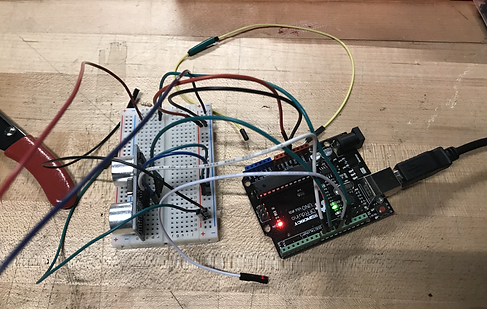
To ensure the circuits functioned properly despite the complexity of intertwined wires, two Arduinos were used:
• One Arduino controlled the vibration motors.
• The other Arduino controlled the LED strips.
This division of tasks improved stability and efficiency in managing the components.